
Mecklenburg County Trial Courts
North Carolina's General Court of Justice has appellate, Superior Court, and District Court divisions. Mecklenburg County is listed as District 26 for Superior Court, District Court, and the prosecutorial district. The local trial courts sit in the Mecklenburg County Courthouse in Charlotte, where the Clerk of Superior Court, public terminals, family court, magistrate functions, jury services, and many courtroom operations are centered.
North Carolina court structure controls the local setup. Superior Court handles felony criminal cases, civil cases involving $25,000 or more, and appeals from District Court. District Court handles misdemeanors, infractions, traffic, small claims, family law, juvenile matters, domestic violence, and many first appearances. Magistrates are judicial officers who handle initial criminal process, small claims, summary ejectment, marriage ceremonies, warrants and process, and other statutory duties.
Mecklenburg County Courthouse
832 East Fourth Street
Charlotte, NC 28202
Clerk of Superior Court: 704-686-0400
Public hours: Monday-Friday, 9:00 a.m.-5:00 p.m.
Mecklenburg Courts and Offices
The Mecklenburg County trial-court structure is not a list of separate numbered local courts. It is a county seat for state Superior Court and District Court divisions, supported by offices that handle case records, prosecution, defense, specialty programs, and public access. The court and office table below reflects the local contacts documented in the Mecklenburg Judicial Branch contact directory.
| Court / Office | Role | Address | Phone |
|---|---|---|---|
| Mecklenburg County Superior Court | Felonies, larger civil cases, and appeals from District Court | 832 East Fourth Street, Charlotte, NC 28202 | Clerk 704-686-0400 |
| Mecklenburg County District Court | Misdemeanors, infractions, traffic, small claims, family, juvenile, and first appearances | 832 East Fourth Street, Charlotte, NC 28202 | District Court Judges 704-686-0101 |
| Clerk of Superior Court | Records, public terminals, paper files, probate, estates, payments | 832 East Fourth Street, Charlotte, NC 28202; PO Box 37971, Charlotte, NC 28237-7971 | 704-686-0400 |
| Magistrates - Civil/Small Claims | Small claims, summary ejectment, and civil magistrate functions | Mecklenburg County Courthouse / Magistrate office | 704-686-0560 |
| Family Court | Domestic and family case management | Mecklenburg County Courthouse | 704-686-0202 |
| Drug Treatment Court | Recovery court program | District 26 program | 980-314-1950 |
| District Attorney, Prosecutorial District 26 | Criminal prosecution for Mecklenburg County | 700 East Trade Street, Charlotte, NC 28202 | 704-686-0700 |
| Public Defender, Defender District 26 | Indigent criminal defense | 700 East Trade Street, Charlotte, NC 28202 | 704-686-0900 |
Note: The Register of Deeds is listed separately for marriage and land records, but it is not a trial court office.
Superior, District, and Magistrates
Mecklenburg County readers often search "district court" when they really need to know which trial-court level holds a record. The key split is between Superior Court, District Court, and magistrate functions. A felony indictment belongs with Superior Court. A misdemeanor, infraction, traffic citation, small claim, domestic case, or juvenile matter usually begins or remains in District Court. Magistrates handle early or limited functions, not full case records for every later stage.
| Point | Superior Court | District Court | Magistrates |
|---|---|---|---|
| Main role | Felonies, larger civil cases, and appeals from District Court | Misdemeanors, infractions, traffic, small claims, family, juvenile, domestic violence, first appearances | Initial criminal process, warrants/process, small claims, summary ejectment, and marriage ceremonies |
| Civil amount | Generally $25,000 or more | Many civil cases under the Superior Court threshold and small claims routes | Small claims and summary ejectment functions as assigned by law |
| Criminal work | Felony trials, indictments, sentencing, and appeals from District Court | Misdemeanors, infractions, first appearances, traffic-criminal matters, and preliminary stages | Arrest warrants, initial appearances or processes, and release conditions where authorized |
| Record access | Portal, clerk files, and public terminals | Portal, clerk files, and public terminals | Processes may appear in the later case file once filed, served, or returned |
Mecklenburg Case Flow
Case movement depends on subject matter, amount, and charge level. Criminal cases may start with an arrest, citation, warrant, or magistrate order. Misdemeanors and infractions usually remain in District Court unless appealed or transferred by law. Felony matters may begin in District Court for early appearances and move to Superior Court after indictment or other transfer. Civil cases route by amount and type, while estates and special proceedings route through the Clerk of Superior Court as judge of probate.
Criminal flow: Arrest or citation › Magistrate or first appearance › District Court setting › Indictment or transfer for felony matters › Superior Court arraignment › Pretrial motions › Plea or trial › Judgment and sentence › Appeal if allowed.
Civil flow: Complaint or petition filed › Service › Answer or response › Motions and discovery › Mediation or hearing › Trial or order › Judgment › Appeal or post-judgment collection.
Estate or special proceeding flow: Filing with Clerk of Superior Court › Clerk review or qualification › Notices, inventories, hearings, or orders › Accounting or final order › Review or appeal where law allows.
Mecklenburg Court Record Access
Online court access for Mecklenburg County runs through the NC Judicial Branch Portal. Portal can search court records, court dates, documents, payments, and judgment information for public matters. For a local search, use Smart Search and choose Mecklenburg County in advanced location filtering. Search Hearings is the better tool for court dates, hearing types, party names, attorney names, judicial officers, and courtrooms.
Public records at the courthouse are available during regular office hours. For records filed before October 9, 2023 that do not appear in Portal, Mecklenburg instructions route criminal requests to meckcriminalrecords@nccourts.org, civil requests to meckcivilrecords@nccourts.org, and estate special proceeding requests to meckestates@nccourts.org. Include record type, party names, and file number if known.
Mecklenburg Treatment Courts
Mecklenburg County is linked by the Judicial Branch location page to several recovery and treatment court resources. These programs may affect hearings, conditions, treatment compliance, sanctions, and review dates, but they do not replace the underlying trial-court case file. Use the main case number in Portal or with the clerk to track the official case record.
The mental health treatment court source is shown in the image from the North Carolina Mental Health Treatment Courts page.
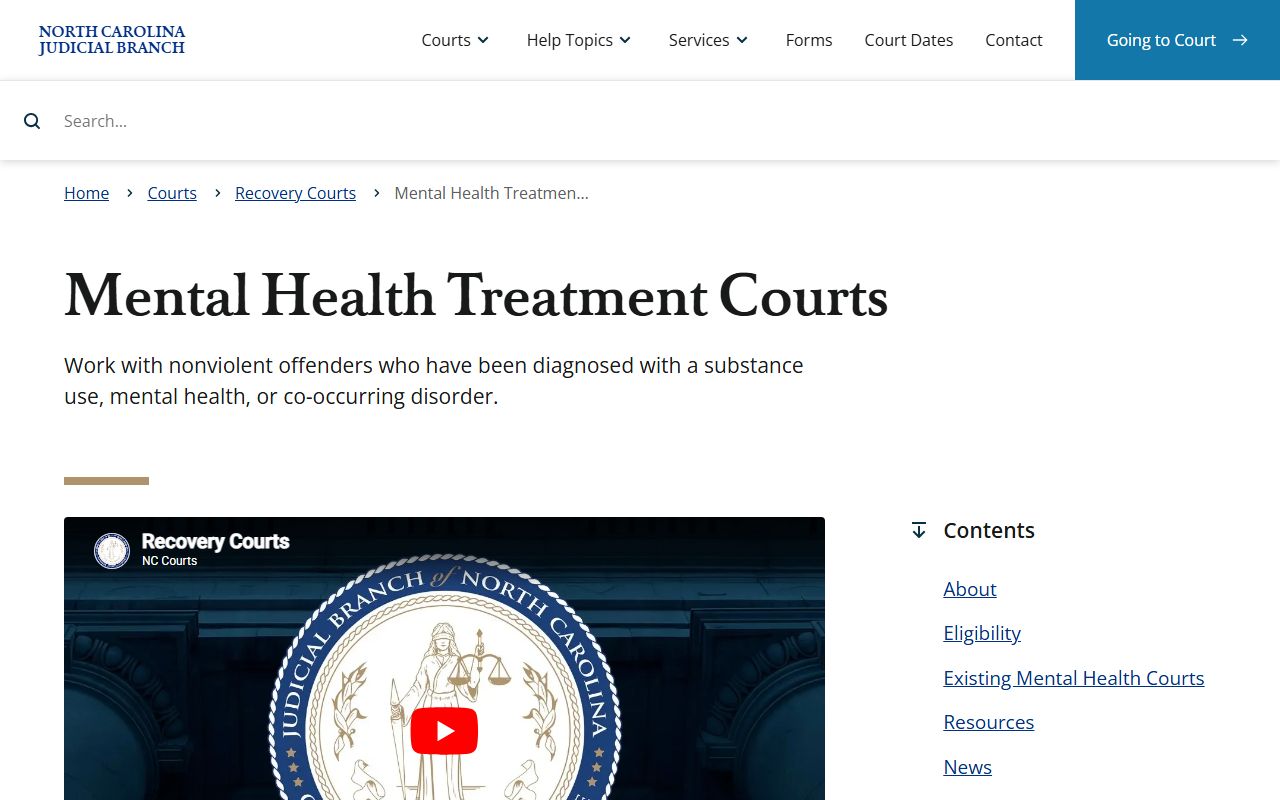
Mental health program references should be read with confidentiality limits in mind because detailed mental-health proceeding records are not ordinary public lookup records.
The veterans treatment court source is shown in the image from the North Carolina Veterans Treatment Court page.
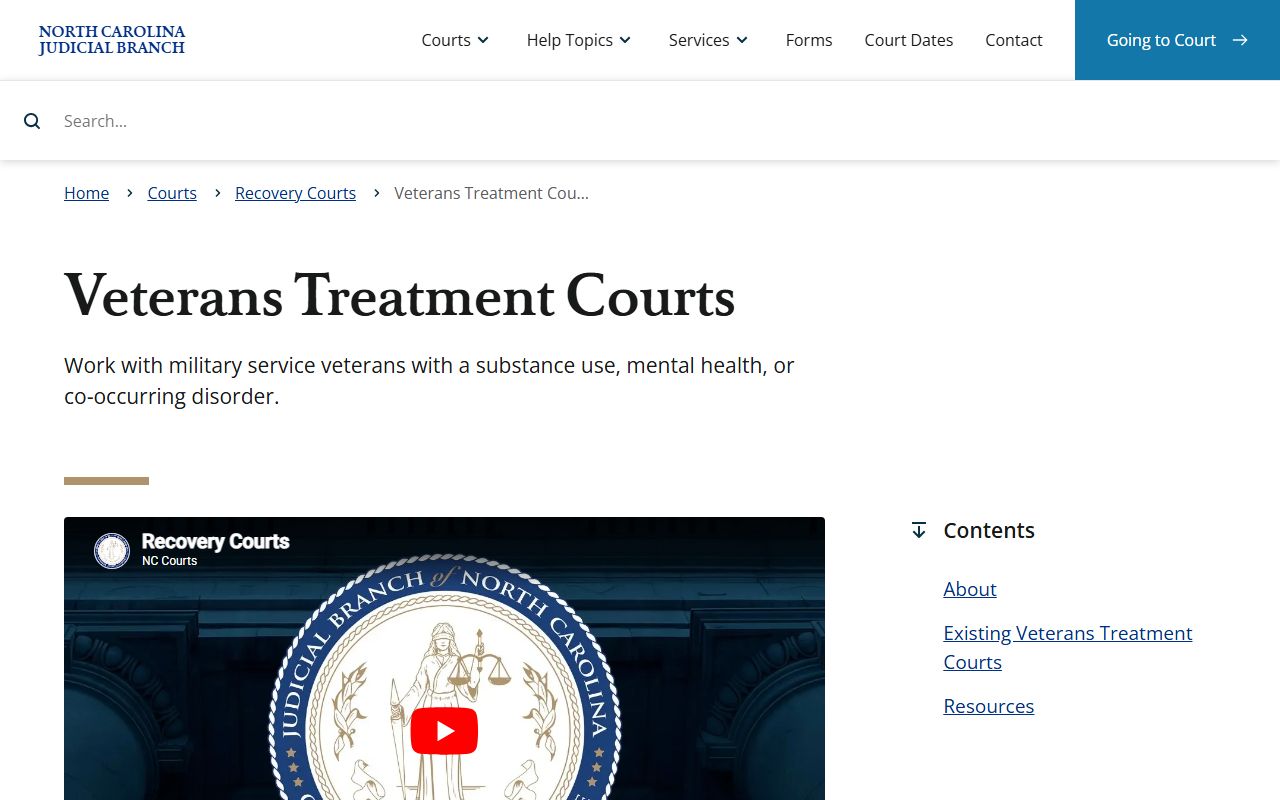
Veterans treatment resources may appear alongside criminal case activity, but certified court records still come from the clerk.
The youth treatment court source is shown in the image from the North Carolina Youth Treatment Court page.
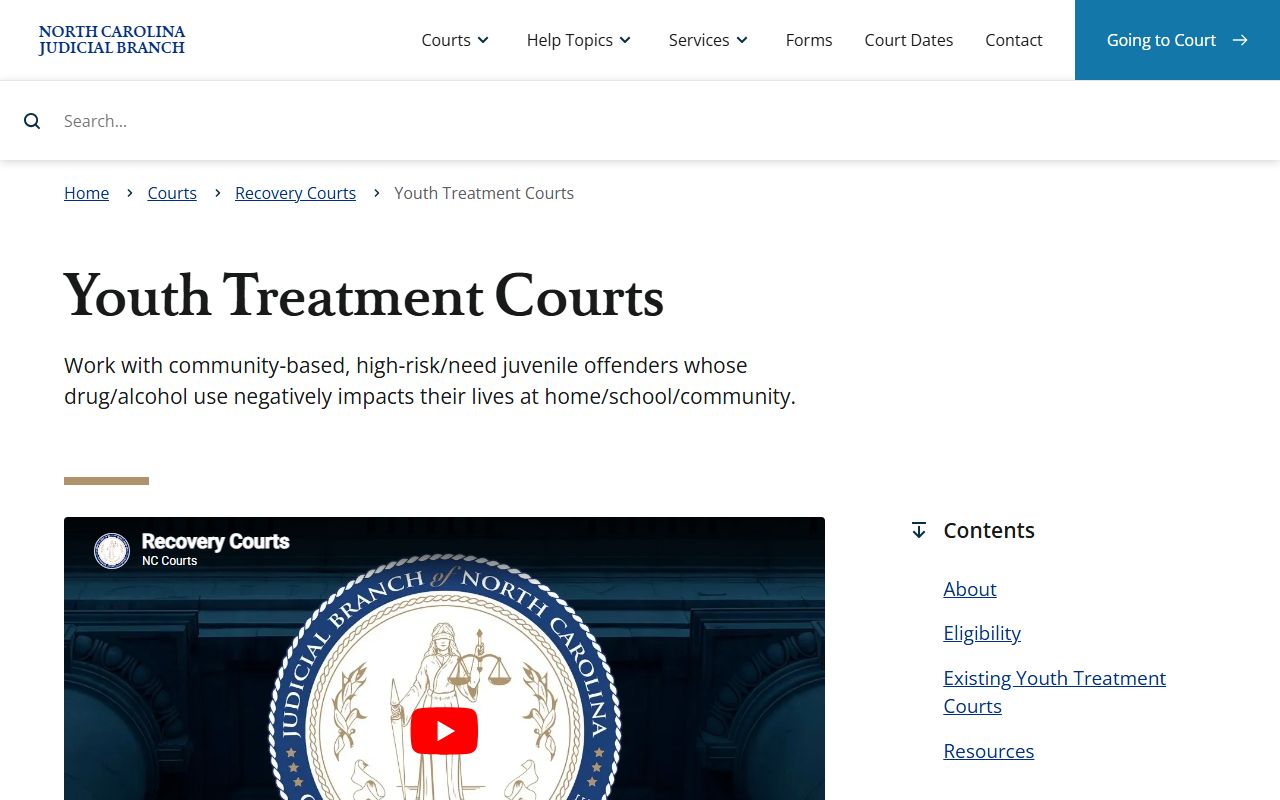
Youth treatment references are useful for court-structure context, but juvenile records are generally restricted under North Carolina law.
Federal Court Boundary
Some Charlotte cases are not Mecklenburg County trial-court cases. Federal criminal cases, federal civil rights claims, federal statutory claims, diversity cases, federal agency litigation, and bankruptcy matters use federal systems. Mecklenburg County is in the U.S. District Court for the Western District of North Carolina. The Charlotte Division is at 401 West Trade Street in the Charles R. Jonas Federal Building, and federal electronic records use PACER rather than NC Portal.
The Charlotte federal court source is shown in the image from the Western District of North Carolina Charlotte Division page.
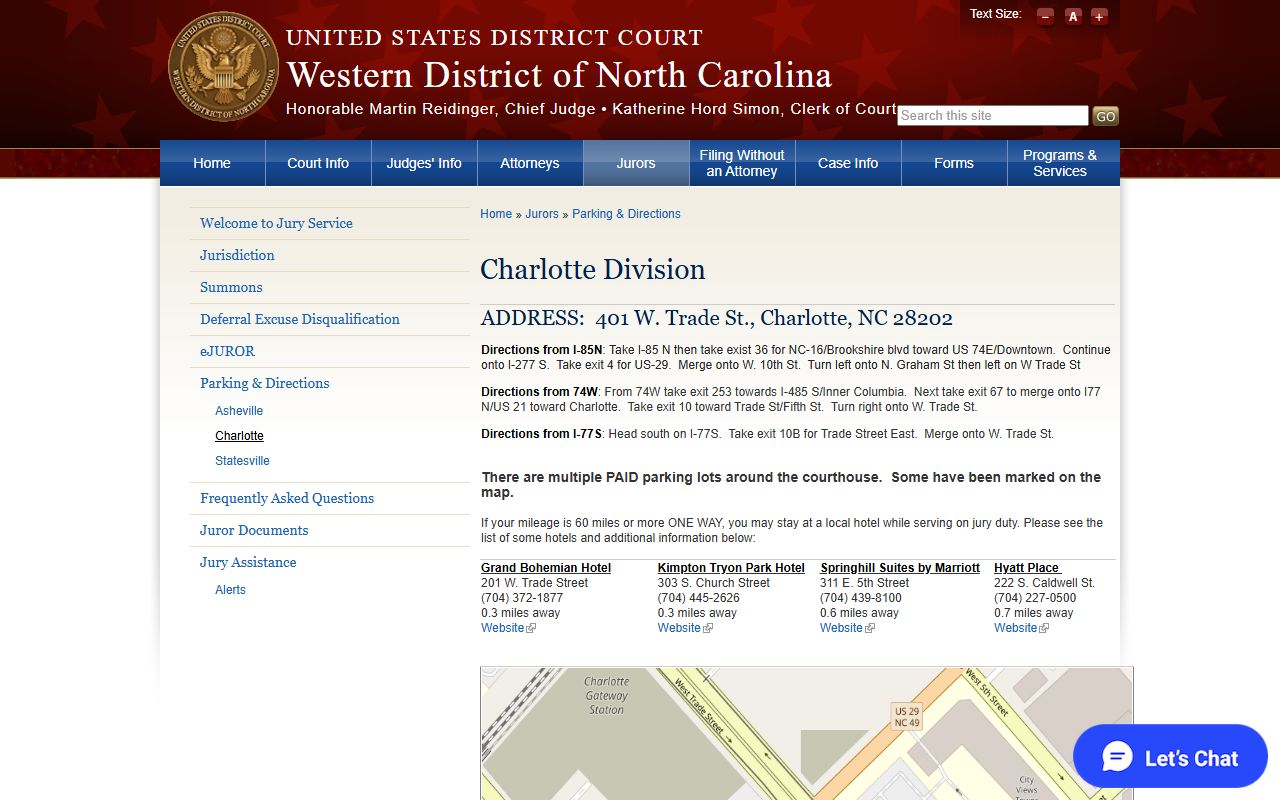
That federal courthouse address is separate from Mecklenburg County courthouse records, even though both are in Charlotte.
The bankruptcy court source is shown in the image from the U.S. Bankruptcy Court for the Western District of North Carolina.
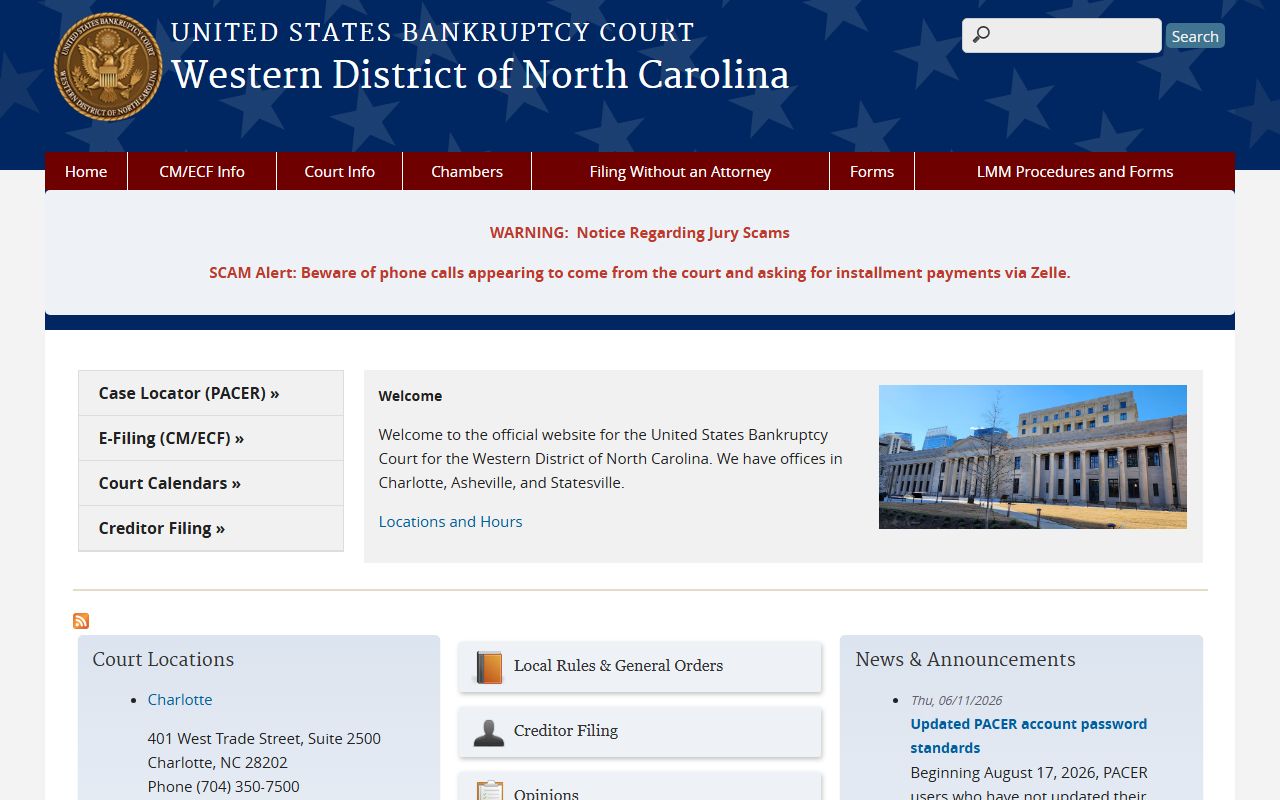
Bankruptcy records are federal court records, so they are not searched through the Mecklenburg County Clerk of Superior Court.
Court Cases and Custody
Court records and custody records often overlap but are not the same file. A District Court or Superior Court criminal case can show charges, hearings, dispositions, bond orders, and financial obligations. The Sheriff's inquiry tools show arrest, inmate, process, bond, and hold information from the custody side. Jail payments and deposits are operational records, not trial-court docket entries.
The GTL deposit source is shown in the image from the GTL online payment page.
That custody-payment source is included only to mark the boundary between jail operations and the court case record kept through the clerk and Portal.
Restricted Court Records
Public access is broad, but not all Mecklenburg County trial-court records are public. Juvenile delinquency and undisciplined records are governed by Chapter 7B Article 30 and are not treated as ordinary public records. Adoption records are restricted. Mental-health proceeding details are usually confidential even if a hearing category appears in a search tool. Sealed and expunged records can be hidden from Portal, clerk inspection, and sheriff inquiry tools.
North Carolina public court access depends heavily on N.C.G.S. 7A-109, which opens clerk records to public inspection unless access is prohibited by law. For county administrative records outside court files, N.C.G.S. Chapter 132 applies. When access is unclear, use the clerk for court documents, the sheriff for arrest or custody records, the Register of Deeds for marriage records, and the county public-record portal for county agency records.