
Search Mecklenburg County Court Records
The main online route for Mecklenburg County court records is the NC Judicial Branch Portal. Mecklenburg moved into eCourts on October 9, 2023, so Portal is the first place to search public case information, court dates, documents, and eligible payments. Anonymous users can search public information without registration. Registered users can save cases, while elevated access is limited to users who have a verified legal or business need allowed by statute.
Portal is not the only access channel. Paper files and public terminals remain available through the Mecklenburg Clerk of Superior Court, and older documents filed before October 9, 2023 may need a division email request if the document is not visible online. Criminal file requests go to meckcriminalrecords@nccourts.org, civil files go to meckcivilrecords@nccourts.org, and estate or special proceeding requests go to meckestates@nccourts.org. Include the record type, party names, and file number if known.
The Judicial Branch Mecklenburg County page is the local starting point for court services, courthouse links, court dates, calendars, payment information, and recovery court references.
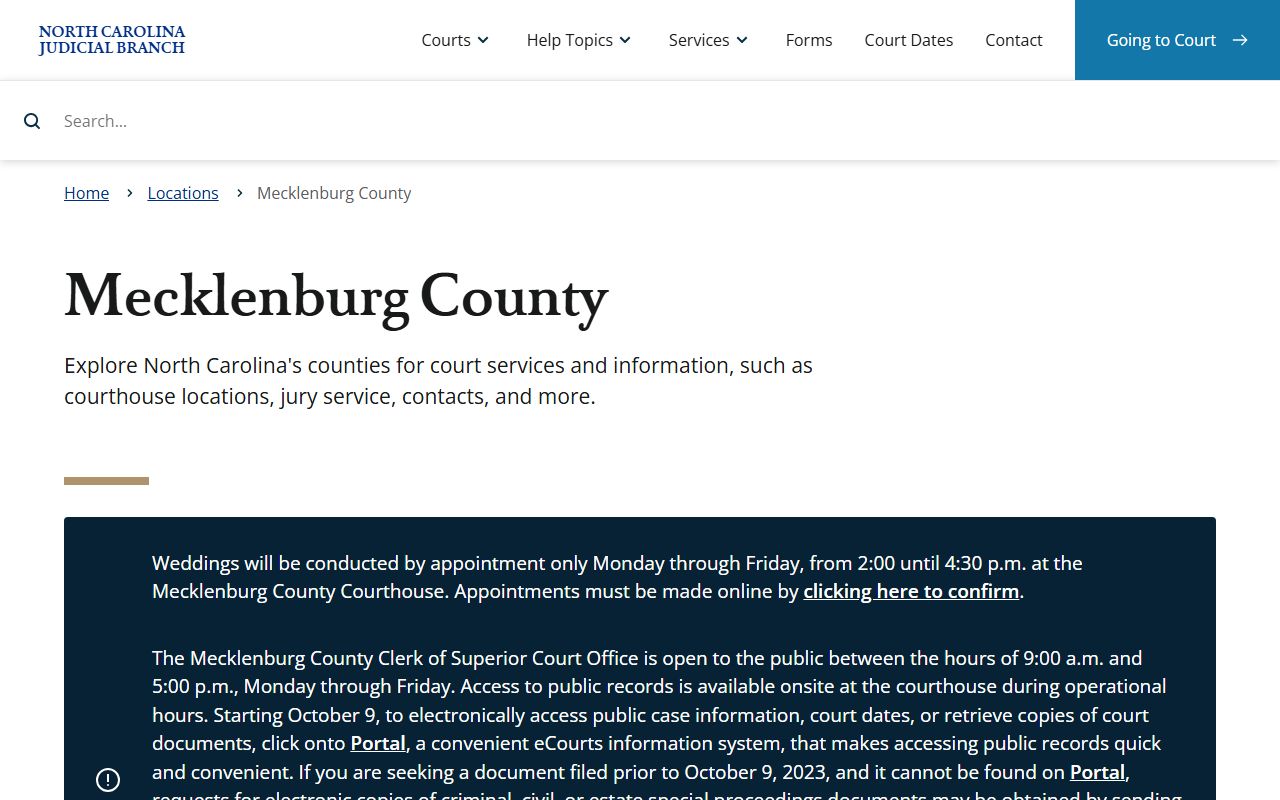
That local page connects the statewide court tools to the Mecklenburg courthouse, clerk, calendars, payment paths, and related court programs.
- Open Portal and choose Smart Search for case records.
- Enter a case number or a name in Last, First Middle Suffix format.
- Use Advanced Filtering Options and set the location to Mecklenburg County.
- Add a case type, case status, file-date range, date of birth, or other identifier when the name is common.
- Open the case summary or register of actions, then use the clerk for certified copies or older paper documents.
Where Mecklenburg County Records Are Kept
Mecklenburg County court records are not all kept by one office. The Clerk of Superior Court keeps Superior Court and District Court case records, including civil, criminal, family, traffic, judgments, liens, special proceedings, estates, and older paper files. The Mecklenburg County Sheriff's Office keeps jail, arrest, resident inquiry, civil inquiry, detention, and arrest-processing information. The Mecklenburg County Register of Deeds keeps marriage licenses, marriage certificates, real estate instruments, notary records, and other recorded county documents that are not court files.
The Mecklenburg County Courthouse page gives the key courthouse access rules for court records, including public access during office hours and the eCourts transition note for older documents.
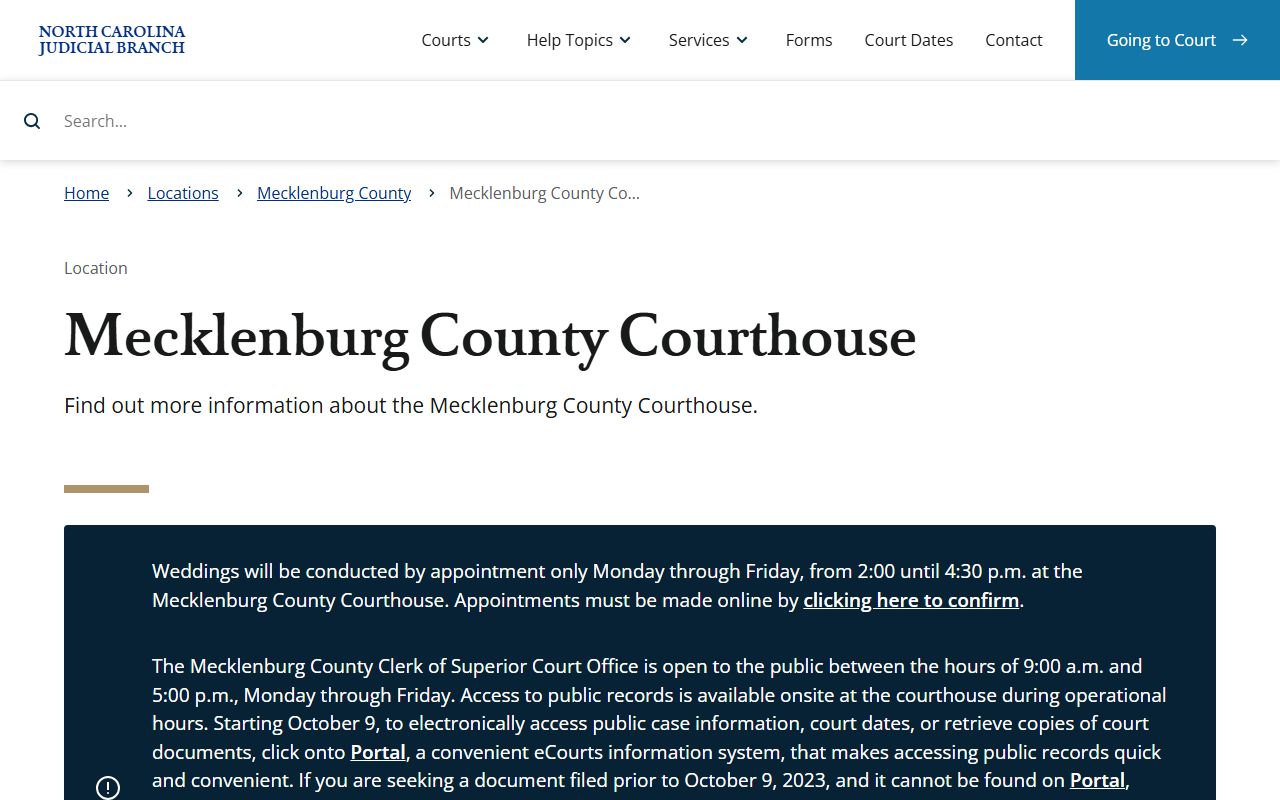
For readers who need a paper file, certified copy, courthouse terminal, or division email, the courthouse page is more useful than a broad statewide search page.
| Office | Records handled | Primary access channel |
|---|---|---|
| Clerk of Superior Court | Court case files, judgments, traffic cases, estates, special proceedings, divorce judgments | Portal, public terminals, paper file counter, division email |
| Mecklenburg County Sheriff's Office | Arrest inquiry, inmate inquiry, resident status, detention, warrant verification channel | MCSO inquiry tools, Public Information Office, phone |
| Register of Deeds | Marriage licenses, marriage certificates, real estate instruments, notary records | Register web access, Permitium, mail, in person |
Mecklenburg County Court System
North Carolina uses one statewide General Court of Justice, not separate local court systems. Mecklenburg County is District 26 for Superior Court, District Court, and the prosecutorial district. Superior Court handles felony criminal cases, civil matters above the District Court threshold, and appeals from District Court. District Court handles misdemeanors, infractions, traffic, small claims, many family matters, juvenile proceedings, domestic violence matters, and many first appearances.
Magistrates are part of the local court process even though they are not a separate trial court. They handle initial criminal processes, certain small claims, summary ejectment matters, warrants and other process, marriage ceremonies, and other statutory duties. The Clerk of Superior Court is also central to the system because the clerk keeps court records and serves as judge of probate for estates and many special proceedings.
The North Carolina court structure page explains the appellate, Superior Court, and District Court divisions that apply in Mecklenburg County.
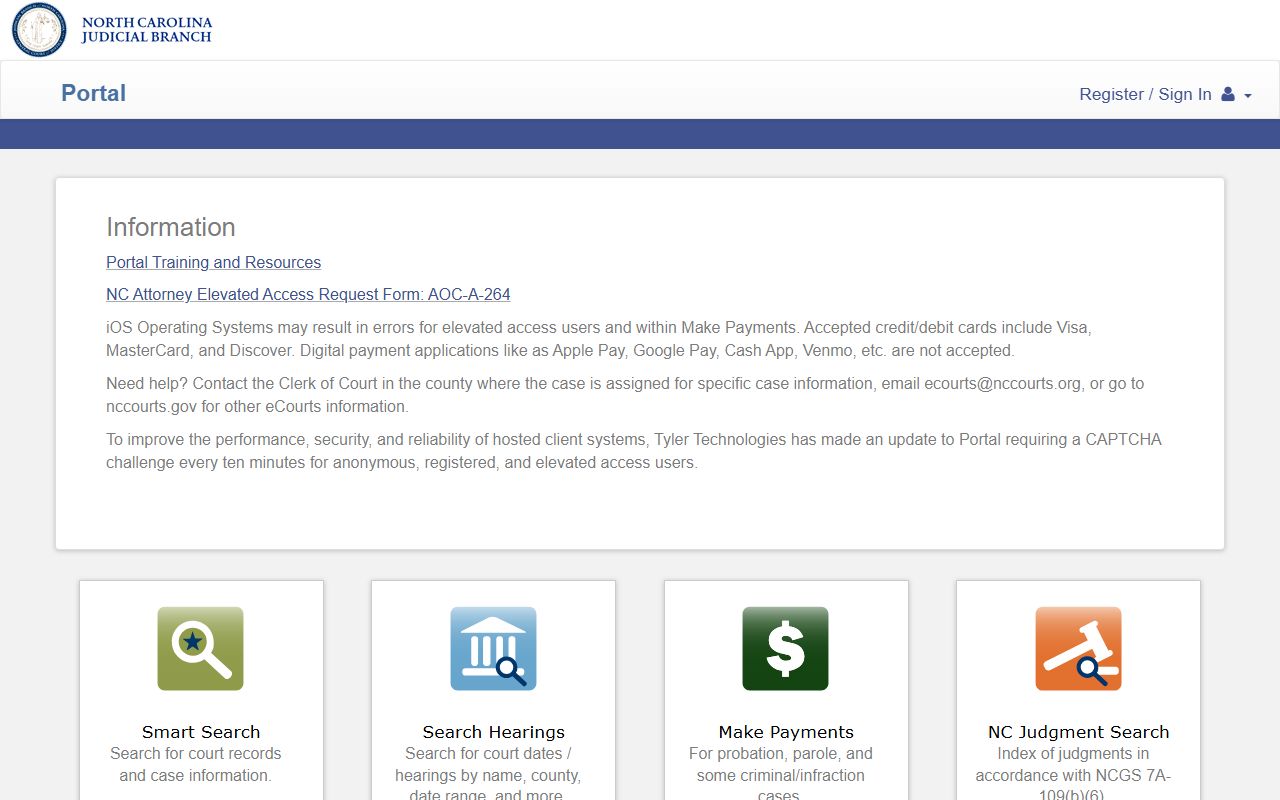
Portal brings those statewide divisions into one search interface for public case records, hearing searches, payments, and judgment searches.
Case flow: Magistrate or citation process › District Court first appearance or hearing › Superior Court for felonies, appeals, or larger civil matters › North Carolina Court of Appeals › Supreme Court of North Carolina.
Mecklenburg County Portal Fields
Smart Search works best when the search is narrow. A party name can work, but common names in a county the size of Mecklenburg often need the location filter, file-date range, case type, status, date of birth, or a known case number. Portal wildcard rules are strict: case number wildcard searches need at least four characters, business or nickname wildcard searches need at least four characters plus an asterisk, and person-name wildcard searches need at least three last-name characters plus an asterisk and one first-name character plus an asterisk.
The Portal training and resources page describes Smart Search, Search Hearings, Make Payments, Judgment Search, registration, elevated access, and the types of case details Portal may display.
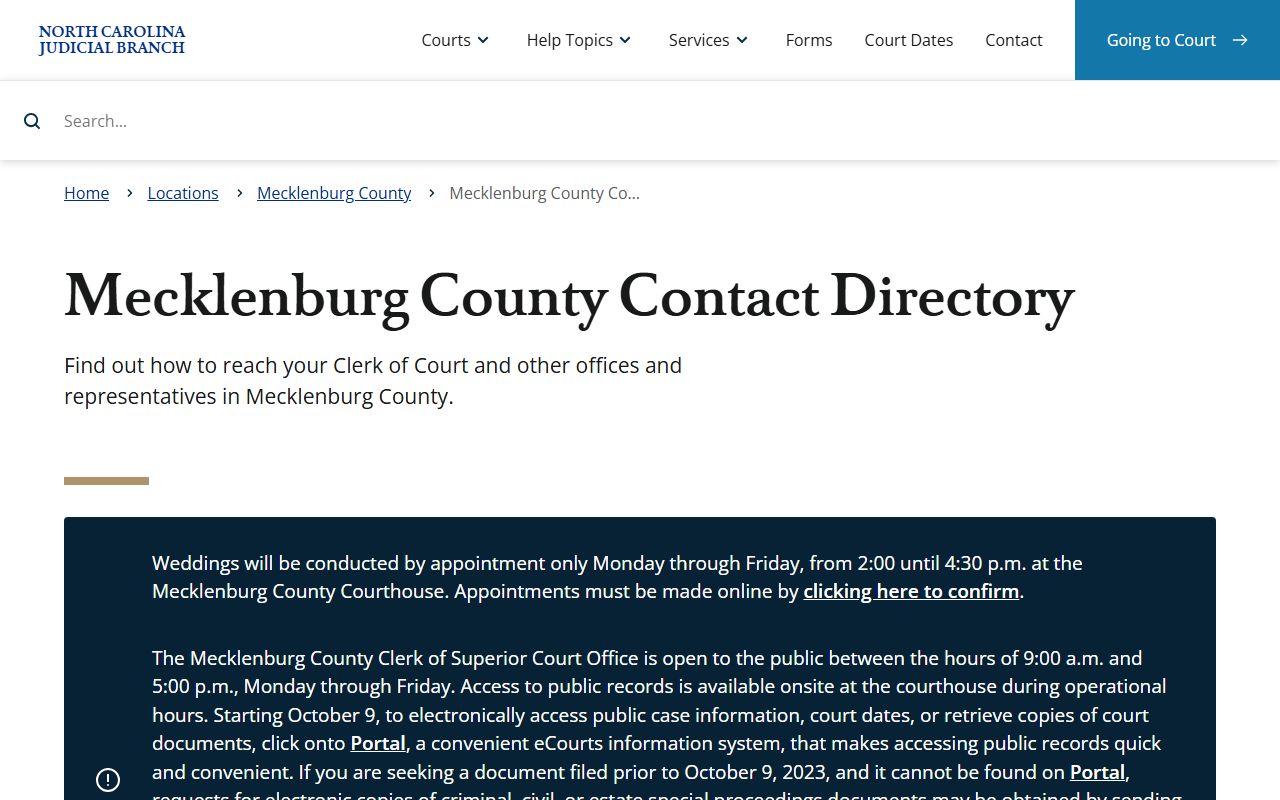
The local contact directory is the fallback when a Portal result does not answer a case-specific question or when a user needs the right clerk division.
| Search field | Use | Mecklenburg note |
|---|---|---|
| Record number or name | Starts a Smart Search | Use Last, First Middle Suffix format for names. |
| Filter by Location | Narrows statewide results | Choose Mecklenburg County when searching local cases. |
| Case type and status | Limits broad name searches | Useful for civil, criminal, family, probate, and mental health categories. |
| File date start and end | Targets a filing period | Helpful for older cases near the October 9, 2023 eCourts transition. |
| Search Hearings | Finds court dates | Can search by case number, party, attorney, judicial officer, or courtroom. |
What Mecklenburg County Records Show
A public court case record may show case information, assignment information, party information, causes of action in civil, family, probate, and mental health matters where public, case events, dispositions, hearings, and financial information. A criminal case file can show charges as filed, hearings, pleas, motions, orders, verdicts, judgments, sentencing, probation conditions, and court costs. A docket is the chronological event list, while the case file may include documents and orders that need a separate copy request.
These fields should not be read as a full background check. The Judicial Branch states that people performing background checks should use the county clerk's office rather than relying only on Portal. Arrest and inmate records from MCSO are also separate from a court conviction. A person can be arrested or charged without being convicted.
- Docket
- A chronological list of filings, hearings, orders, and events in a case.
- Disposition
- The current or final result of a charge, claim, or case event.
- Judgment
- A final enforceable court decision that may create costs, liens, or other duties.
- Expunction
- A court order that removes eligible criminal records from public criminal history.
Mecklenburg County Payments and Copies
Eligible fines, costs, traffic waivers, probation, parole, and some criminal or infraction payments can be handled online through Portal payment tools. The Mecklenburg County payment information page also gives mail and in-person payment rules for the Clerk of Superior Court.
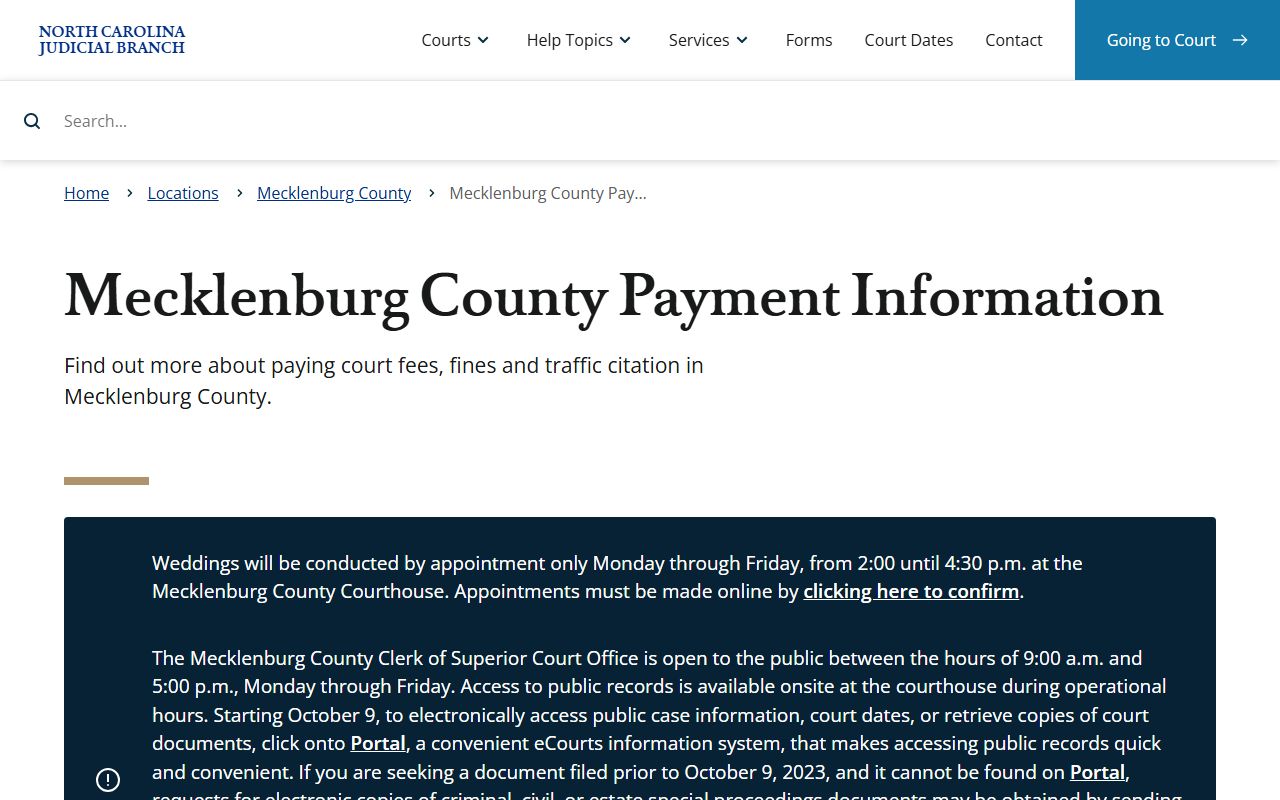
Payment rules matter because a traffic or criminal record may show fines, costs, failure to pay, or license consequences tied to the clerk's payment channel.
| Payment or copy path | Accepted channel | Important limit |
|---|---|---|
| Portal payment | Online for eligible cases | Visa, MasterCard, and Discover are listed, but Apple Pay, Google Pay, Cash App, Venmo, and similar apps are not accepted. |
| Mail payment | Clerk mailing address | Money order or certified check only, payable to Mecklenburg County Clerk of Superior Court. |
| In-person payment | Cashier's Office at courthouse | Cash, card with processing fees, money order, and certified check accepted. Personal checks are not accepted. |
| Certified court copies | Clerk of Superior Court | Use the clerk, not Portal alone, when a certified copy is needed for legal use. |
Mecklenburg County Sheriff Records
The Mecklenburg County Sheriff's Office is separate from the Clerk of Superior Court. Sheriff Garry L. McFadden leads MCSO, which maintains detention, arrest processing, resident inquiry, inmate inquiry, civil inquiry, and related public information channels. Detention operations, arrest processing, and dispatch operate every day. The sheriff's public inquiry systems are useful for arrest and jail status, while the court case record is found through Portal or the clerk after a case is filed.
The Mecklenburg County Sheriff's Office website is the local source for detention links, arrest processing, visitation, commissary, resident inquiry, and contact information.
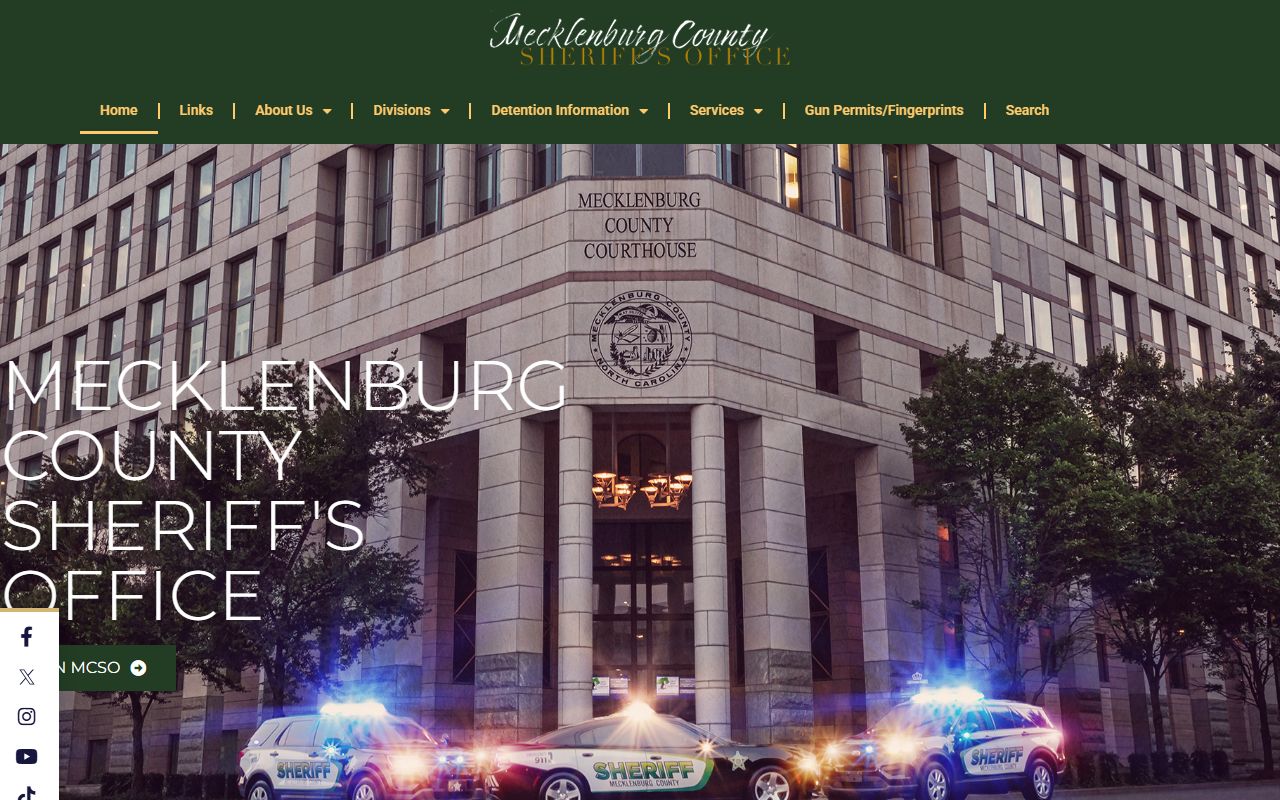
The sheriff site is most useful for jail and arrest status, while the court portal is still needed for filed criminal cases and court outcomes.
MCSO arrest and inmate inquiry data has a local retention rule. The information generally remains online for three years from arrest or release from the detention center. Early removal requires an expunction order signed by a judge.
The MCSO resident inquiry page warns users not to confuse charges with convictions and explains the public status of arrest, inmate, and civil inquiry records.
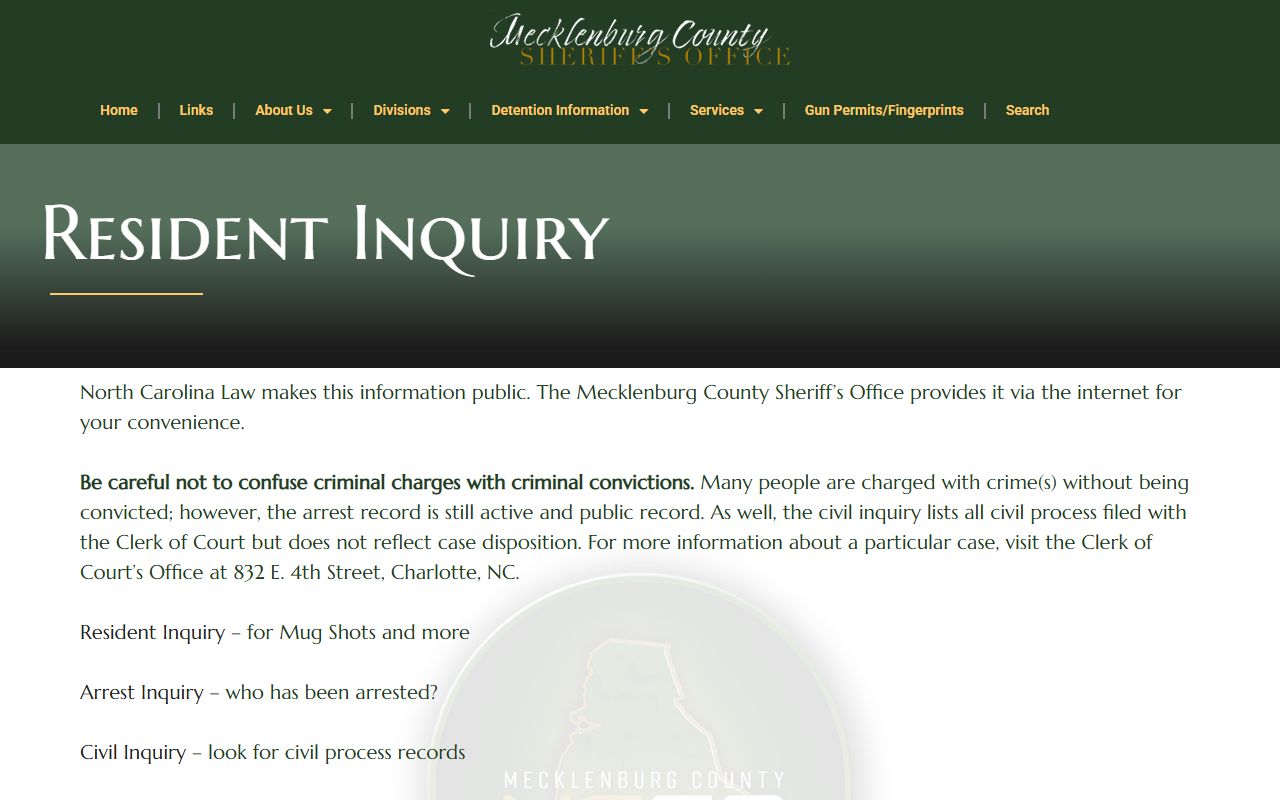
That warning is important when comparing arrest records, court charges, and the final criminal court record.
Mecklenburg County Warrant Checks
Mecklenburg County does not currently offer a reliable public active warrant list through the old MCSO Warrant Inquiry page. The disabled warrant page states that the Sheriff's Office no longer provides warrant information to the public and that unserved warrants are not public records. The safer official route is to use MCSO Arrest Processing, the Public Information Office email channel, Portal for filed court information, or a lawyer when a person may have an outstanding warrant.
The MCSO arrest-processing page explains the eWarrants and eCourts transition, public charge and arrest information, and the direct warrant verification phone channel.
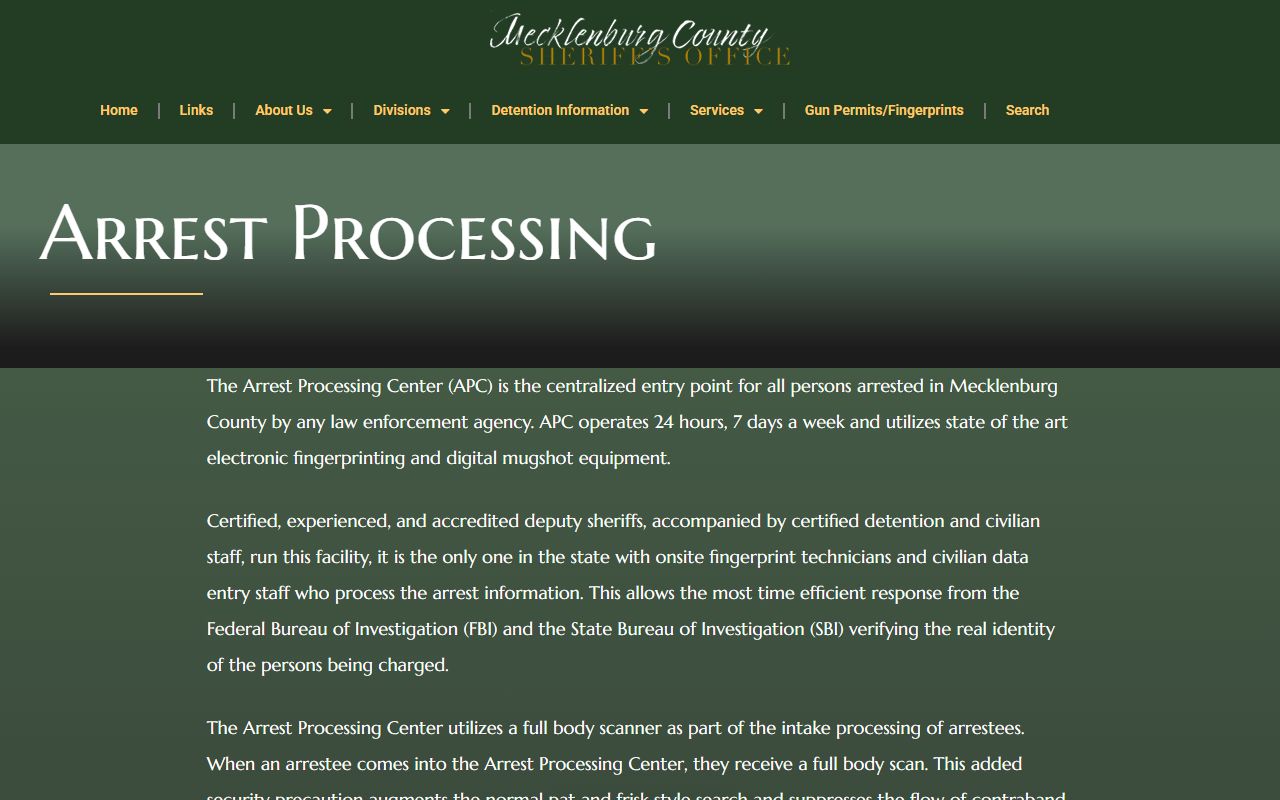
Because unserved warrant data may be withheld, the arrest-processing contact path is more accurate than third-party warrant sites.
Note: Treat warrant payment calls with caution. MCSO has warned about scam callers posing as sheriff personnel and demanding money.
Mecklenburg County Marriage and Probate
Marriage records are not court records in Mecklenburg County. The Register of Deeds issues marriage licenses and certified marriage certificate copies from the County & Courts Office Building. The Register also handles real estate instruments, notary records, and other recorded documents. Divorce judgments, by contrast, are court records kept by the Clerk of Superior Court in the county where the divorce was granted.
The Mecklenburg County Register of Deeds website is the local source for marriage licenses, marriage records, recorded documents, office hours, fees, and online request links.
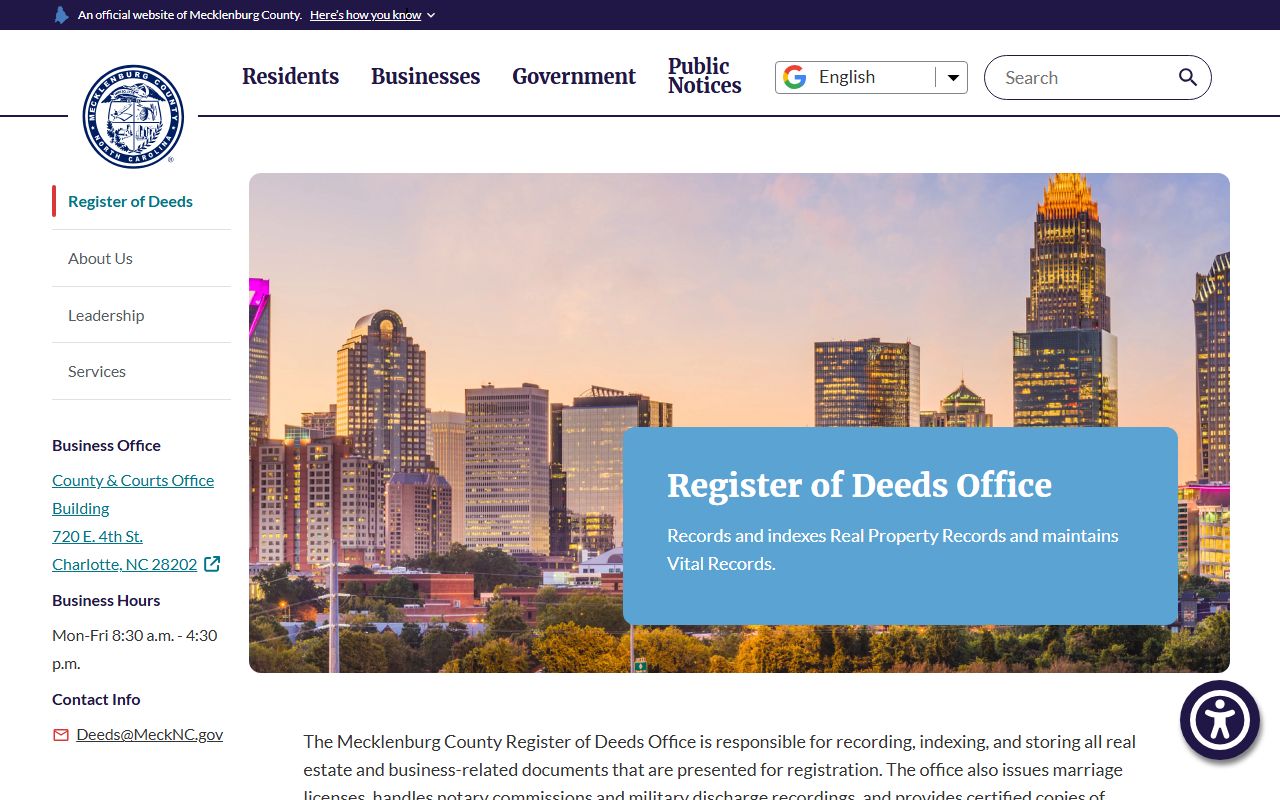
The office split is important: a marriage certificate request belongs with the Register of Deeds, while a divorce judgment belongs with the clerk.
Probate in Mecklenburg County is handled by the Clerk of Superior Court as judge of probate, not by a separate probate court. Estate files may include wills, applications to administer an estate, letters, inventories, accountings, creditor claims, year's allowance documents, guardianship matters, and clerk orders. Public estate information can appear in Portal, but older estate and special proceeding documents may need the estates email channel.
Mecklenburg County Traffic Records
Traffic citations in Mecklenburg County usually move through District Court unless the offense becomes a felony or is otherwise transferred. The court traffic record is different from the NCDMV driver record. The court record can show citation number, offense, court date, waiver, disposition, costs, failure to appear, and failure to pay. The driver record is held by NCDMV and can show license status, convictions as reported, points, suspensions, and driver-history data subject to DPPA rules.
For traffic cases, use Portal or citation payment tools first, then the Mecklenburg Clerk of Superior Court for in-person or mail payment, certified copies, or case-specific questions. If a court date is missed, North Carolina courts can report a failure to appear to NCDMV after 20 days if unresolved. If ordered costs are not paid, failure to pay can be reported after 40 days.
Mecklenburg County Public Access Laws
North Carolina law supports public inspection of many court records, but the rule is not the same for every document. Court records are governed most directly by the clerk recordkeeping statute, while county administrative records fall under the broader public records law. Juvenile, expunged, sealed, adoption, mental health, and some protected personal information are handled under narrower rules.
Key Statutes:
N.C.G.S. 7A-109 requires clerks to keep records, dockets, indexes, judgments, liens, estates, special proceedings, criminal actions, and other required records open to public inspection unless law says otherwise.
N.C.G.S. Chapter 132 defines public records for North Carolina agencies and is the main path for county administrative records outside court files.
N.C.G.S. Chapter 7B Article 30 places juvenile court records outside ordinary public case access.
Restricted Mecklenburg County Records
Some records are not public even when a case exists. Juvenile delinquency and undisciplined records are restricted. Adoption records are not ordinary family files. Mental health proceedings are usually confidential, even though Portal may group some hearing search categories under probate or mental health. Expunged and sealed cases may not appear in ordinary public search results. Public records may also redact Social Security numbers, financial account data, driver's license or passport numbers, protected minor information, passwords, PINs, and similar identifiers.
For criminal records, expunction is the local correction path when a record is eligible under North Carolina law. Mecklenburg filings go through the Clerk of Superior Court for the county case. If a judge signs an expunction order, the clerk and state or local agencies process it. MCSO requires the signed order to remove arrest or inmate inquiry information before its usual three-year display period ends.
Mecklenburg County Specialty Courts
Mecklenburg County is linked by the Judicial Branch to recovery and treatment court programs, including Adult Treatment Court, Family Treatment Court, Mental Health Treatment Court, Youth Treatment Court, and DWI Treatment Court. These programs can affect criminal, family, juvenile, and impaired-driving cases because they add treatment, supervision, compliance, and review hearings to the ordinary court path.
Recovery court references should be read with care. Statewide program pages describe general goals and statutory authority, while Mecklenburg-specific eligibility and case status must come from the court, lawyer, or program office. The local contact directory lists Drug Treatment Court at 980-314-1950.
Federal Courts in Charlotte
Mecklenburg County also has federal court activity in Charlotte. The U.S. District Court for the Western District of North Carolina uses the Charlotte Division at the Charles R. Jonas Federal Building. Federal criminal prosecutions, federal civil cases, bankruptcy matters, and federal appeals are not found in NC Portal. Use PACER and the federal court clerk for official federal case records.
The Western District of North Carolina, U.S. Bankruptcy Court, U.S. Attorney, U.S. Marshals, and the Fourth Circuit may all matter when a Mecklenburg case involves federal charges, federal custody, bankruptcy, or appeal. Federal custody records can also differ from the Mecklenburg jail roster, even when a federal detainee is temporarily held locally.
Mecklenburg County Court History
Mecklenburg County court access has a long local and statewide history. North Carolina Superior Courts date to 1777, and Superior Court judges rotate among districts to reduce conflicts from fixed local assignment. Mecklenburg's modern District 26 court system sits inside that statewide structure, with Charlotte as the county seat and the East Fourth Street court campus serving as the local center for court, sheriff, detention, and record offices.
Recent history is just as important for records access. Mecklenburg moved to eCourts on October 9, 2023, creating a bright line between newer online records and older documents that may still need a clerk division email or paper-file request. By October 13, 2025, eCourts was live across all 100 North Carolina counties.
Mecklenburg County Court FAQ
Can I search Mecklenburg County court records by name?
Yes. Portal Smart Search allows name searching, but a common name should be narrowed by Mecklenburg County, case type, status, file-date range, or date of birth when available.
Where are certified court copies obtained?
Certified court copies come from the Mecklenburg Clerk of Superior Court. Portal can help locate a case, but the clerk is the official source for certified copies and older paper files.
Are Mecklenburg County arrest records the same as criminal court records?
No. MCSO arrest inquiry records show arrest and booking-side information. Criminal court records show the filed court case, hearings, pleas, dispositions, and sentences.
Is there a public Mecklenburg County warrant search?
No reliable public active warrant list was confirmed. The MCSO warrant inquiry is disabled, and unserved warrants may not be public. Use MCSO Arrest Processing or legal counsel for warrant verification.
Who handles Mecklenburg County marriage records?
The Mecklenburg County Register of Deeds handles marriage licenses and certified marriage certificate copies. Divorce judgments are court records handled through the clerk.
What changed after October 9, 2023?
Mecklenburg County moved to eCourts and Portal on that date. Newer public case information is searched online, while older missing documents may need a division email request.