
Mecklenburg County Jail Roster
The Mecklenburg County Sheriff's Office runs the local jail and inmate inquiry channels. MCSO headquarters is at 700 E. 4th Street in Charlotte, and the information line is 704-336-8100. The sheriff's office states that detention operations, arrest processing, and dispatch operate 24 hours a day, 365 days a year. Sheriff Garry L. McFadden is identified in the research as the sheriff of Mecklenburg County.
The MCSO Inmate Inquiry is the main online tool for county jail residents and recent custody information. The Inmate FAQ says the system works in real time, so changes to an inmate's record display immediately after the record is changed. It also says the system contains three years of data. MCSO did not document an official mobile app in the research, so the inmate lookup should not be described as app-based.
The MCSO Inmate Inquiry page is the primary public entry point for Mecklenburg County inmate records.
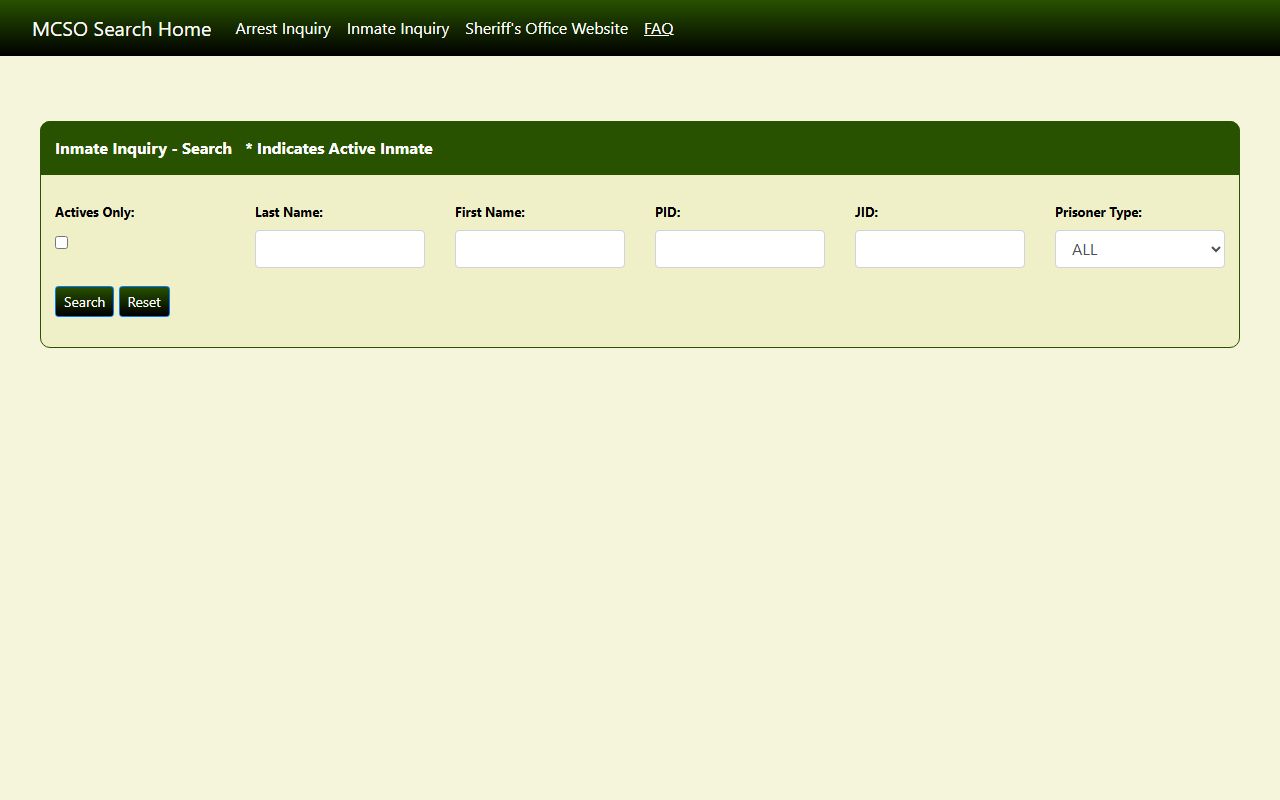
The roster is best for custody and booking facts. Court charges, hearings, pleas, and dispositions should be checked in Portal or with the Clerk of Superior Court.
Use the Mecklenburg County Inmate Roster
The roster can be searched broadly, but precise searches reduce false matches. Name searches require at least one first-name letter if using a name. PID and JID searches can be more exact when those identifiers are known. The Actives Only checkbox limits results to people currently in custody.
- Open MCSO Inmate Inquiry and decide whether to search all records or active inmates only.
- Enter a last name and at least one first-name letter, or search by PID or JID if the identifier is known.
- Use Prisoner Type only when custody category matters, such as STATE, FEDERAL, BOP, ICE, or 287G.
- Review the result list for name, PID, JID, height, weight, and visible custody details.
- Open the matching inmate profile and compare charge, process, bond, and booking data with court records when case status matters.
Search errors matter. The research lists notices for too many fields, an error occurred, no results, and more than 500 records found. If a broad name search fails or returns too many people, narrow it with PID, JID, first-name letters, or active-only status. If no online result appears but the matter is urgent, use MCSO by phone rather than assuming the person is not in custody.
Mecklenburg County Inmate Search Fields
The Inmate Inquiry search form has more than a simple name box. It lets a user narrow by active status, person name, positive identification number, jail identification number, and prisoner type. Those fields are local to the MCSO search interface and should be used before turning to broader state or federal systems.
| Field Label | Type | Required | Options / Format Notes |
|---|---|---|---|
| Actives Only | Checkbox | Optional | Limits to active inmates. FAQ calls this Active Inmates Only. |
| Last Name | Text | Optional unless name search | Maximum length 30. |
| First Name | Text | At least one letter if searching by name | Maximum length 30. |
| PID | Text | Optional | Positive Identification Number, maximum length 15. |
| JID | Text | Optional | Jail Identification Number, maximum length 15. |
| Prisoner Type | Dropdown | Optional | ALL, STATE, FEDERAL, BOP, ICE, 287G; FAQ also defines SMCP. |
| Search / Reset | Buttons | Not applicable | Button labels are Search and Reset. |
| Pagination | Page controls | Not applicable | Previous, numbered pages, and Next. |
Note: The roster search is for jail custody records, not statewide criminal history or certified court outcomes.
Mecklenburg County Inmate Profile Fields
An inmate result gives a public snapshot of the jail record. The FAQ says result cards include name, PID, JID, height, and weight, while the public template and FAQ also identify image, date of birth, race, ethnicity, sex, alias, arrest number, address, date committed, charge fields, and other incarceration details. The saved mugshot default is bitmap at 400 by 480 pixels.
| Field | What It Shows |
|---|---|
| Mugshot or image | Public result image when available; FAQ describes saved mugshot format. |
| Name and alias | Legal or displayed name and any alias name listed in the summary. |
| PID | Positive Identification Number based on fingerprint analysis and constant across stays. |
| JID | Jail Identification Number assigned at booking and changed for each stay. |
| DOB, race, ethnicity, sex, height, weight | Identity and descriptor fields used to separate similar names. |
| Arrest number and date committed | Booking or custody event identifiers and custody timing. |
| Case and charge description | Trial court case number, docket information, and text charge description. |
| Process, charge, bond, and bond type | Custody reason, misdemeanor/felony/traffic/infraction code, bond amount, and release category. |
PID and JID are often confused. PID is based on fingerprint identification and stays consistent across multiple bookings. JID is tied to a specific jail stay. When matching a jail profile to court records, PID can help identify the person while the court case number links the custody event to the court file.
Detention Center Central
Mecklenburg County Detention Center Central is the main jail facility described in the research. MCSO says the direct-supervision facility opened in 1997, and a second tower added in 2002 brought capacity to more than 1,900 residents. MCSO describes it as the largest municipal detention center in North and South Carolina. The facility is pretrial, has a full-service medical component with an infirmary, and houses the Arrest Processing Center, centralized property storage, and administrative support services.
Mecklenburg County Detention Center Central
801 East Fourth Street area / MCSO campus
Charlotte, NC 28202
980-314-5200
Detention operations, arrest processing, and dispatch operate 24/7/365 through MCSO.
The Detention Center Central page documents the facility history, capacity, accreditation, medical component, and arrest-processing role.
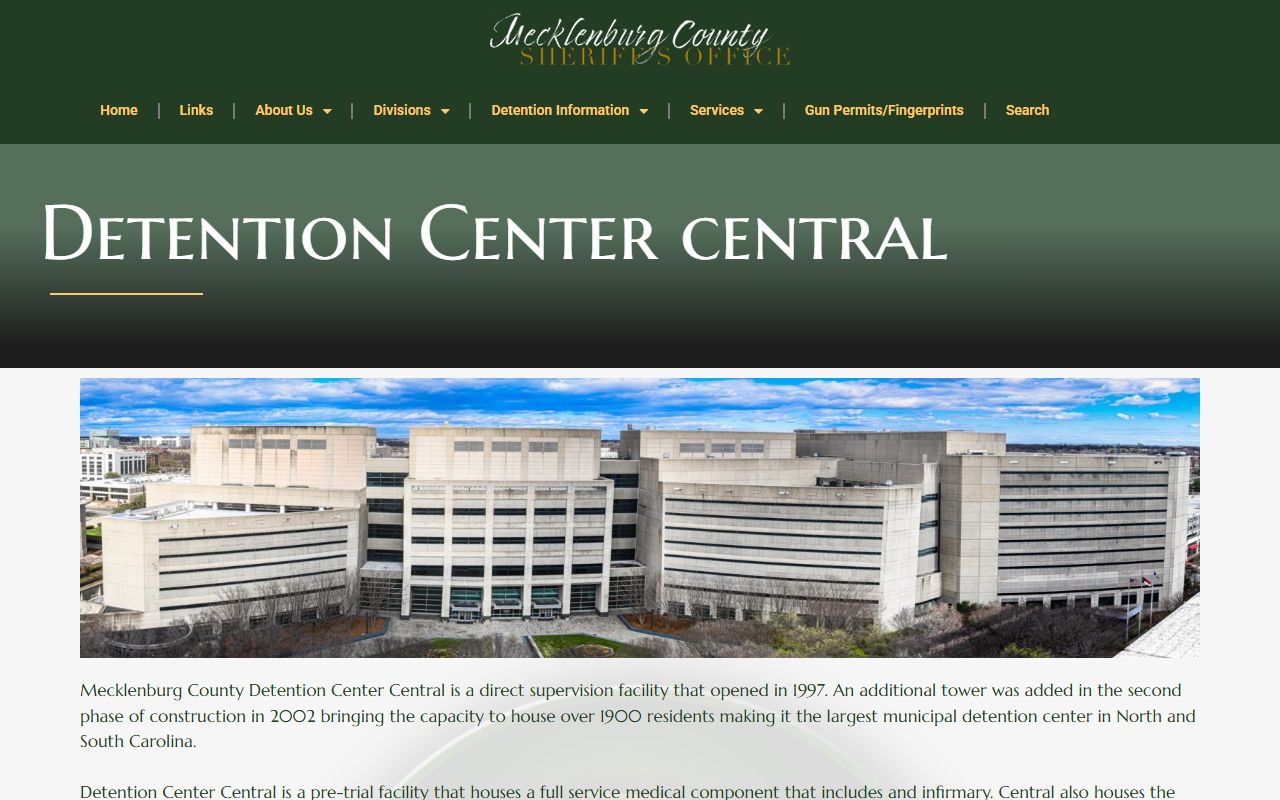
That facility context helps explain why an inmate profile can include booking, medical custody, process, property, and court-adjacent information even though the jail is not the court clerk.
Mecklenburg County Custody Channels
MCSO Inmate Inquiry is only one access channel. Recent arrests and booking-side charge data may also appear in MCSO Arrest Inquiry and Resident Inquiry. A court case filed after charges should be checked in NC Portal Smart Search. Sentenced state prison, probation, or parole information belongs to the North Carolina Department of Adult Correction. Sex-offender registration belongs to the NC SBI registry. Federal custody belongs to federal systems.
- County jail residents: use MCSO Inmate Inquiry for active or recent custody records.
- Recent arrests: use MCSO Arrest Inquiry or Resident Inquiry for booking-side arrest data.
- Court case after charges: use Portal Smart Search or the Mecklenburg Clerk of Superior Court.
- Sentenced state custody: use the North Carolina Department of Adult Correction offender search.
- Federal or BOP custody: use federal sources when prisoner type or hold information points outside county custody.
- Phone or in person: call MCSO information at 704-336-8100 or use the detention campus around 700 to 801 E. Fourth Street.
No official MCSO mobile app was found in the research sweep. Do not substitute a third-party app for the sheriff's roster or describe app-only inmate lookup features that the official source did not document.
Charges, Bonds, and Holds
Inmate profiles may include charge and process terms that look terse until decoded. MCSO defines CASE as the trial court case number, docket, and number. DESCRIPTION is the charge text. PROCESS TYPE is the process causing custody. CHARGE TYPE marks misdemeanor, felony, traffic, or infraction. BOND and BOND TYPE show release conditions. These fields help connect a jail profile to Mecklenburg County arrest records and court charges.
- Charge types
- M is misdemeanor, F is felony, T is traffic, and I is infraction.
- Bond types
- SEC is secured, UNS is unsecured, CASH is cash only, CUST is custody of another, and NONE means no bond allowed.
- Judicial process
- FTA means failed to appear, FTC means failed to comply, GJI means grand jury indictment, and PV means probation violation.
- Holds
- FED, ICE, OOC, STATE, WRIT, MHE, DDRCRT, SDRCRT, and STEP point to other custody, court, or program contexts.
A person can have more than one charge or hold. One arrest can produce several court charges, and one inmate profile can reflect local, state, federal, immigration, or other-county custody issues. A bond listed on one charge does not always resolve all holds.
Mecklenburg County Inmate Visitation
MCSO visitation rules apply to family, friends, attorneys, clergy, and authorized officials within facility security conditions. The general rule permits visits regardless of custody security level unless privileges are suspended for disciplinary sanctions. A resident also has the right to refuse regular visitation. Visits must be scheduled at least 24 hours in advance, and the visit is automatically canceled if the visitor arrives 10 minutes after the scheduled time.
| Visit Type | Schedule / Rule | Notes |
|---|---|---|
| Public/personal visitation | 8:00 a.m.-11:00 a.m.; 1:00 p.m.-4:00 p.m.; 8:00 p.m.-10:00 p.m. | Schedule at least 24 hours in advance. |
| Video visitation | WebRTC through GTL scheduling | iOS users use Safari; Android users need GTL Schedule Visits and GTL Internet Visits apps updated. |
| Free video calls | Two free 10-minute internet video calls per week | Calls cannot be on the same day. |
| Paid internet video | $6.25 for 25 minutes or $2.50 for 10 minutes | Subject to availability and facility conditions. |
| Phone call | One free 5-minute phone call per week | Permanent MCSO program. |
| Clergy visitation | One free 25-minute clergy video and one in-person visit per week | Volunteer Coordinator permission required at 980-314-5172 during business hours. |
| Clergy hours | Monday-Friday and Sunday, 8-11 a.m., 1-4 p.m., 8-10 p.m. | Non-contact and subject to recording. |
The MCSO visitation page documents the local schedule, video provider, visitor ID rules, and parking note.
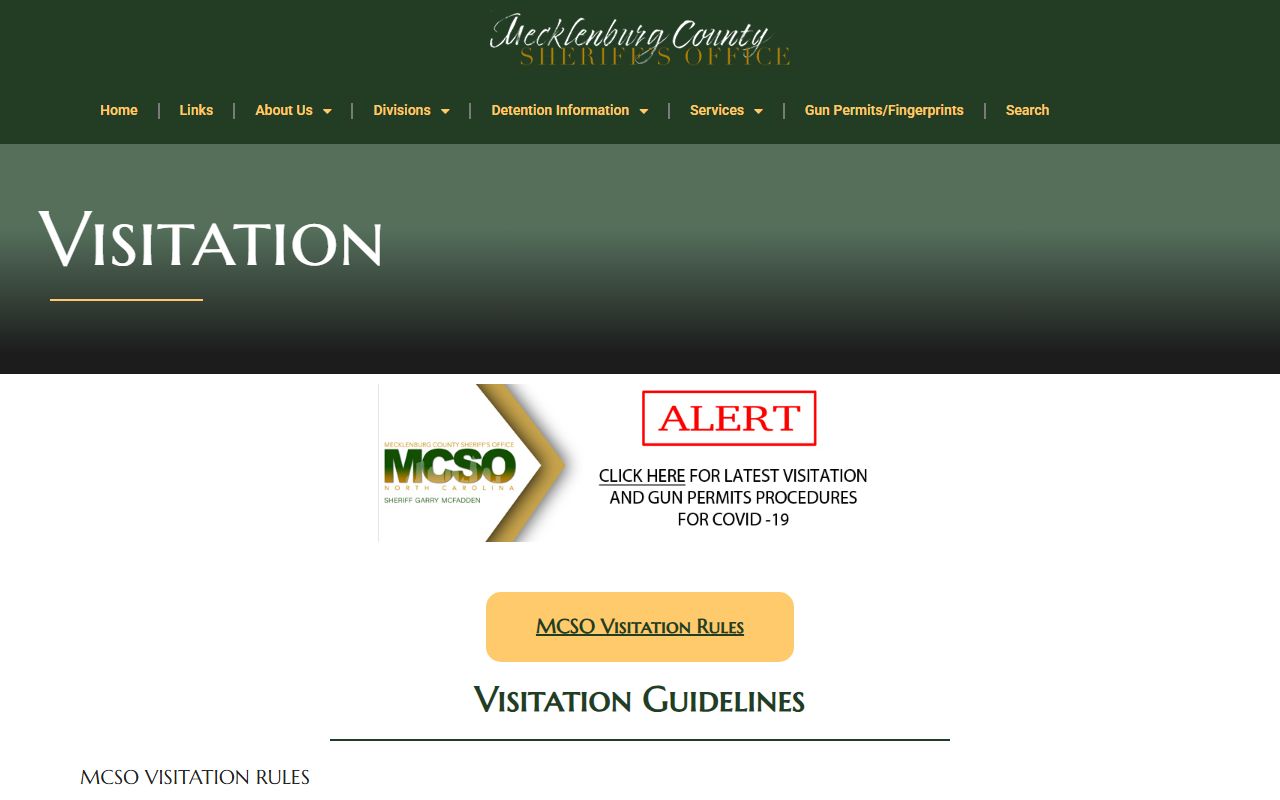
Visitors should bring valid government ID. MCSO will not accept licenses or ID cards if they are cracked, expired, taped, faded, laminated, or apparently altered.
Video Visits and Parking
Video visitation uses the GTL scheduling site. The research notes that iOS users should use Safari at the GTL web address, while Android users need the GTL Schedule Visits and GTL Internet Visits apps updated. Video visits are still governed by facility conditions and scheduling rules, so a scheduled visit can depend on resident status and operational limits.
The GTL video visitation scheduling site is the local video-visit scheduling channel referenced by MCSO.
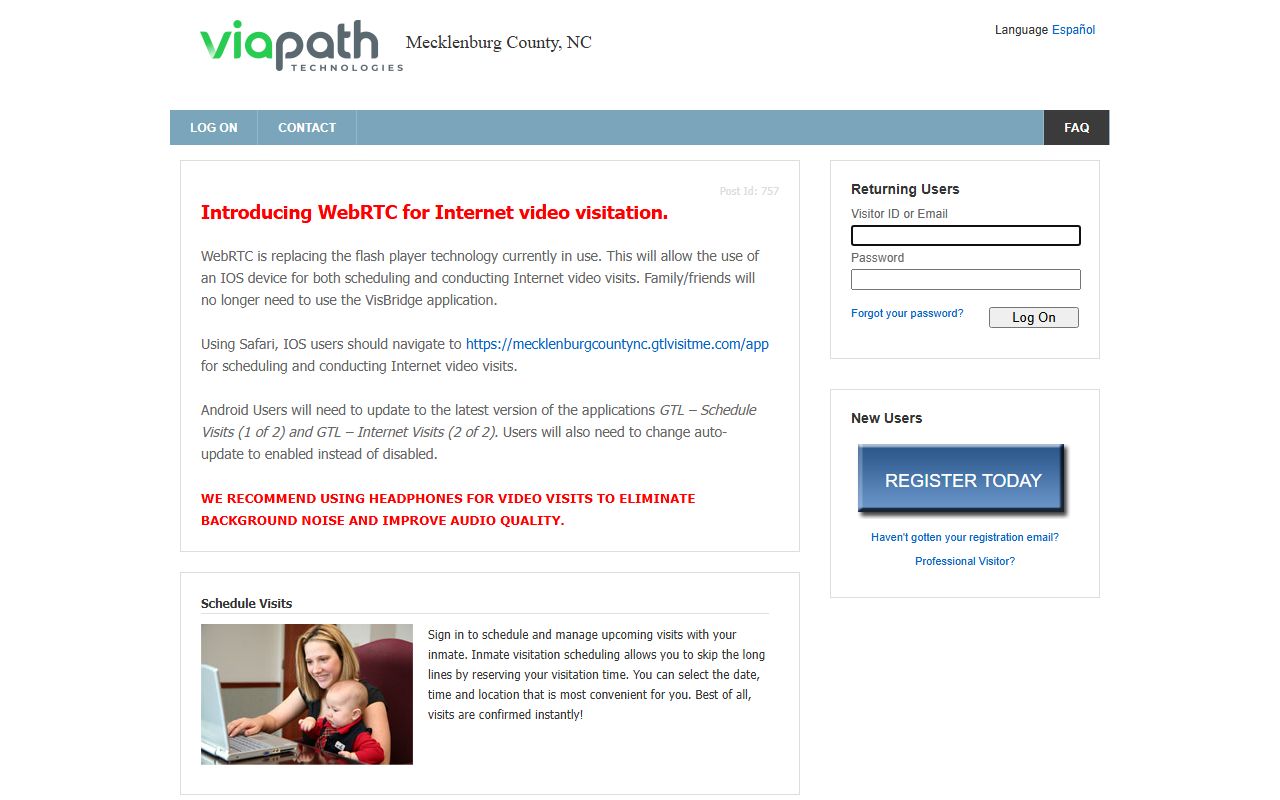
Parking is also local. MCSO says there is no public parking at the Administrative Services Building and directs visitors to the 4th Street Parking Deck at 983 East 4th Street, at 4th and McDowell.
Commissary and Inmate Funds
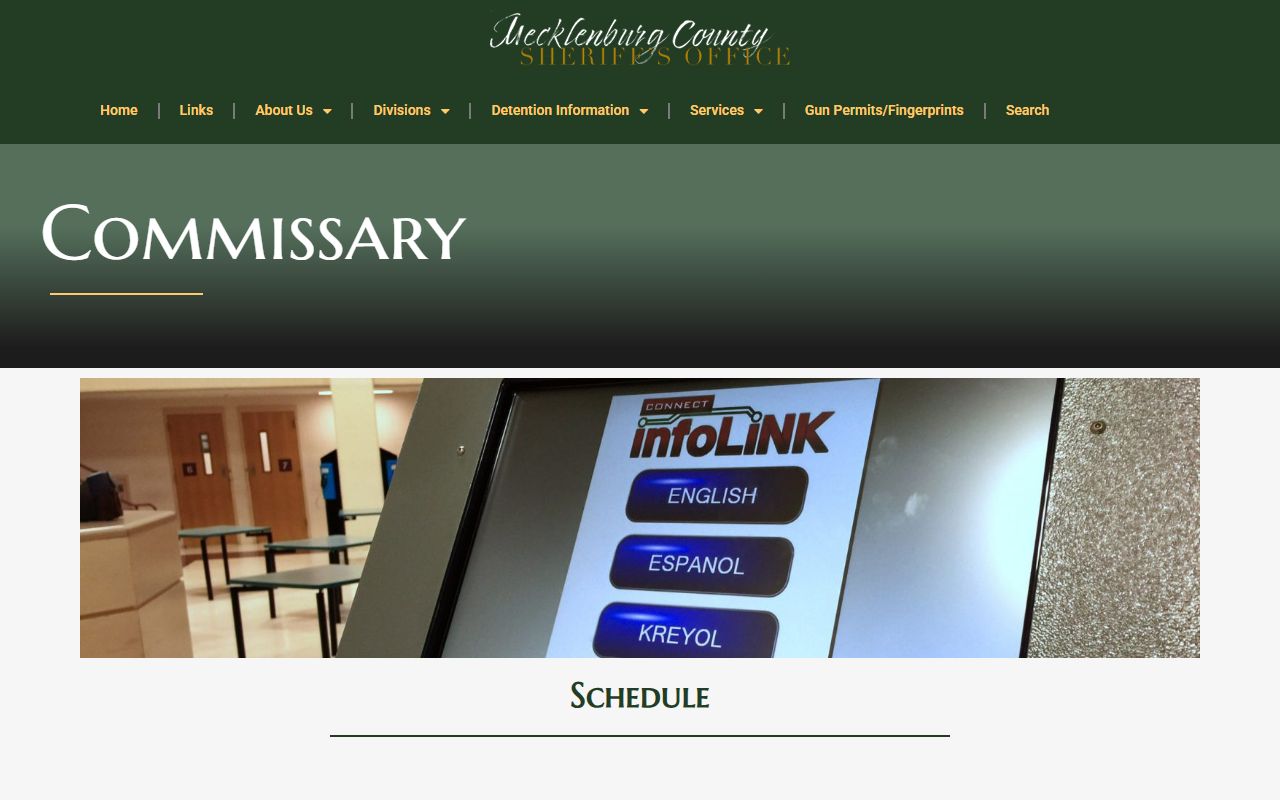
Commissary rules are specific to Detention Center Central. Ordering runs Sunday and Tuesday, 8:00 a.m.-11:30 a.m., 1:00 p.m.-4:30 p.m., and 7:00 p.m.-11:00 p.m. Deliveries occur Tuesday and Thursday. Residents may order twice each week, with a maximum of $50 per order, and only two orders per week regardless of amount. There is no ordering Thursday, Friday, or Saturday.
The MCSO commissary page gives the ordering schedule, order cap, delivery days, and release pickup rule.
Each resident must have an ID bracelet to receive commissary and must sign for the order. Orders not received before release can be picked up from the Finance Division at Detention Center Central Monday-Friday, 8 a.m.-5 p.m., within seven days of release.
The iCare inmate package ordering site is listed by MCSO as an online package option.
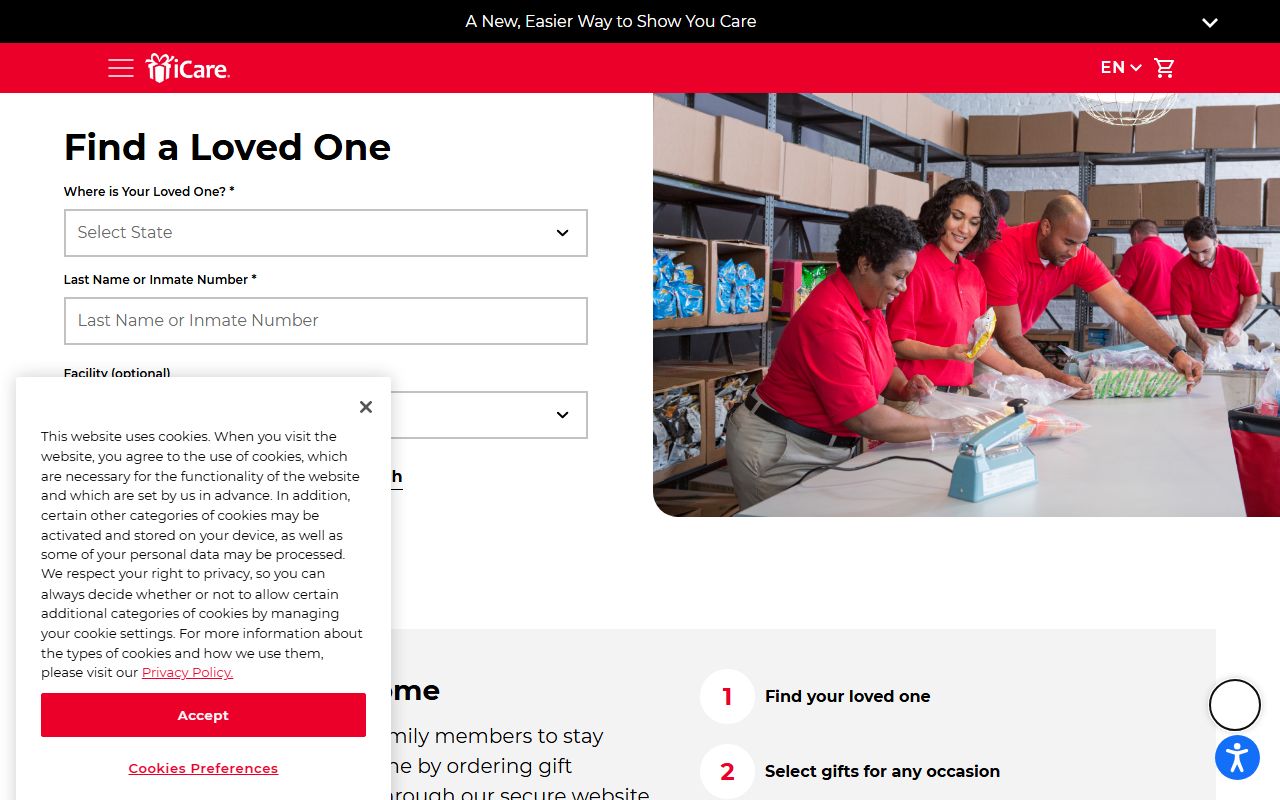
Online package ordering is separate from the jail roster search. Use it only after confirming the person is eligible to receive commissary items.
Deposits and Release Pickup
MCSO lists GTL as the online deposit route. Deposits and packages are operational services, not record searches, but they often matter once a family member confirms a resident is in custody. The commissary schedule and ID bracelet rule still apply even when money is deposited online. A release can also interrupt delivery, which is why the Finance Division pickup window matters.
The online deposit route is not a substitute for bond information. Bond amount and bond type in the inmate profile describe release terms for a charge or process. Commissary deposits are resident funds. A person reviewing Mecklenburg County inmate records should not treat money deposited to a resident account as payment of a court bond.
Deposit details should stay tied to the official MCSO commissary rules and the listed online deposit link rather than a separate record-search source.
Three-Year Inmate Record Retention
MCSO states that arrest and inmate inquiry information remains online for three years from arrest or release. Removal before the three-year period requires an Order of Expunction signed by a judge. That rule matters when a person expects a dismissed or expunged charge to disappear from public inquiry results. The signed order must be provided where MCSO requires it for early removal.
Sealed, expunged, juvenile, adoption, and many mental-health records should not be treated as ordinary public lookup products. Juvenile records are restricted under Chapter 7B Article 30. Public copies can also redact Social Security numbers, financial account numbers, driver's license or state ID numbers, passport numbers, protected minor information, and similar data.
Important: A jail roster entry can show an arrest or charge without proving a conviction or final court outcome.